Silage Making for Cattle: Complete Guide
By Vrap · Published Mon May 18 2026 00:00:00 GMT+0000 (Coordinated Universal Time) · Updated Mon May 18 2026 00:00:00 GMT+0000 (Coordinated Universal Time)
What is silage and why it matters
Silage is green fodder preserved by lactic acid fermentation in an airtight environment. Fresh-cut fodder is chopped, packed tightly to exclude air, sealed, and allowed to ferment. Naturally occurring lactic acid bacteria convert the plant sugars to lactic acid, dropping the pH to around 4.0 and creating a stable, acidic, fermented material that resists further microbial spoilage. Properly made silage can be stored for 6–12 months and fed year-round.
For Indian dairy, silage solves a recurring problem: fodder availability is highly seasonal. The monsoon and post-monsoon (June to November) produce abundant green fodder; the lean dry season (March to May, and increasingly into June) produces little. Without preservation, surplus monsoon fodder is wasted while peak dairying needs additional fresh fodder. Silage bridges this gap, evening out fodder supply across the year and stabilising milk production through the hot, dry summer months.
Silage is also the foundation of a Total Mixed Ration (TMR). The high moisture content of silage (60–70%) supplies the wet bulk that makes a good TMR cohesive and prevents sorting.
Why maize silage is the Indian gold standard
Several forage crops can be ensiled, but maize silage dominates in modern Indian dairy operations:
| Crop | Yield (tons/acre, green) | Suitability for ensiling | Notes |
|---|---|---|---|
| Maize | 25–40 | Excellent | High starch, easy ensiling, gold standard |
| Sorghum (jowar) | 20–35 | Very good | Drought-tolerant alternative to maize |
| Pearl millet (bajra) | 18–30 | Good | Drought-tolerant, lower starch than maize |
| Hybrid napier / Bajra-napier | 30–50 | Good | High-volume, lower nutrient density |
| Oat | 15–20 | Good | Rabi season option |
| Berseem | 30–40 | Tricky | Low sugar, requires wilting + additives |
| Lucerne (alfalfa) | 25–35 | Tricky | Same as berseem - high protein, low sugar |
| Sugarcane tops | 8–12 | Limited | Low protein, but useful when available |
For most Indian dairy farms, maize silage at the dough stage (when the kernels are full and milky but the plant is still green) is the right choice. It harvests at high tonnage, ensiles reliably without additives in most conditions, and produces silage at roughly 8–10% crude protein and 65–70% TDN.
The silage-making process: 7 steps
Step 1: Choose the right harvest stage
For maize, the right harvest stage is the dough stage — when:
- Cobs are formed and kernels are full but still milky-doughy
- Whole plant moisture is around 65–70%
- Lower leaves are starting to yellow but the upper plant is still green
Too early (kernels still milky-only) = too wet, poor energy Too late (kernels hard, plant dry) = too dry, won't compact, poor fermentation
For sorghum, jowar, bajra — harvest at the early dough or boot stage, before the plant gets fibrous.
Step 2: Chop to 1–2 cm
Chop the harvested fodder to 1–2 cm length using a chaff cutter or forage harvester. This particle size:
- Compacts tightly to exclude air
- Releases plant sugars for fermentation
- Produces good final silage texture
Too coarse (over 3 cm) leaves air pockets and risks spoilage. Too fine (under 0.5 cm) reduces effective fibre in the final silage.
Step 3: Pack and compact
Move chopped material into the silo structure (bunker, pit, or bag). Compaction is critical — every air pocket is a potential spoilage point.
For bunker or pit silos, drive a tractor over the chopped material in thin layers (30 cm at a time), packing tightly. Target density: above 700 kg/m³ of fresh chopped material. The more tightly compacted, the less air remains.
For silo bags or plastic-wrapped bales, mechanical packing during the bagging process delivers the compaction.
Step 4: Add additives (optional but recommended)
In most Indian conditions, a bacterial inoculant is the most cost-effective additive:
- Apply at 1–2 g per ton of fresh chopped fodder
- Lactobacillus plantarum + Pediococcus or Enterococcus combinations are common
- Speeds fermentation, lowers final pH, reduces spoilage risk
Other optional additives:
- Molasses (1–2%) — extra fermentable sugar for low-sugar forages (legumes, sugarcane tops)
- Salt (0.5%) — traditional fermentation aid
- Propionic / formic acid (1–2 g/kg) — surface mould suppression for marginal silage
- Urea (0.5%) — non-protein nitrogen for low-protein forages (NOT for any silage fed to calves under 3 months, as per the calf starter urea safety rule)
Step 5: Seal airtight
Cover the silage immediately after the last load. Use plastic sheeting (200–300 micron thickness) overlapped, with the edges weighted by sandbags, tyres, or soil to prevent air infiltration.
For pit silos, fold the plastic sheeting down over the pit walls and into the silage before adding the top layer of weights.
Air is the enemy of silage. Even a small hole allows aerobic spoilage and surface mould to develop. Repair tears immediately when discovered.
Step 6: Fermentation (3–6 weeks)
During the sealed period, three phases of fermentation occur:
| Phase | Time after sealing | What happens |
|---|---|---|
| Aerobic phase | 0–3 days | Residual oxygen consumed by plant respiration; temperature rises briefly |
| Active lactic fermentation | 3–21 days | Lactic acid bacteria multiply, convert sugars to lactic acid; pH drops from ~6 to ~4 |
| Stable fermentation | 21+ days | pH stable at 3.8–4.2; silage is now shelf-stable as long as sealed |
The silage is ready to feed at 21–42 days post-sealing. Earlier feeding (under 14 days) catches the silage mid-fermentation and is less palatable.
Step 7: Daily feeding from a face
When opening the silo, the exposed face is the silage's vulnerability:
- Face it carefully: make a clean vertical cut, not a sloped or jagged surface
- Take only what's needed for the day: typically remove 20–30 cm of face depth daily
- Re-seal nightly if possible (especially for pit silos)
- Don't store opened silage — use what's removed within 24 hours, then return the next day for fresh material
The cleaner and faster the daily face management, the less aerobic spoilage develops on the exposed silage.
Silo types: bunker, pit, bag
Three main silo types are used in Indian dairy:
Bunker silo (above-ground)
- Concrete or compacted earth walls (3–5 m tall, variable length)
- Tractor-compacted in layers
- Covered with plastic + weights
- Capacity: 50–500+ tons depending on size
- Best for: medium to large dairies (25+ animals)
- Cost: ₹3,000–10,000 per ton of capacity
Pit silo (below-ground)
- Dug into the ground, walls lined with brick or concrete (or unlined in compact soil)
- Filled in layers, covered with plastic + soil/weights on top
- Capacity: 20–200 tons
- Best for: small to medium dairies; areas with high water table avoid pit silos
- Cost: ₹2,000–5,000 per ton of capacity
Silo bag / silo bale
- Heavy-gauge plastic bags (silo bags) filled by a baling machine
- Or individually wrapped round bales (silo bales)
- Capacity: silo bags up to 200 tons; silo bales 0.5–1 ton each
- Best for: flexible production, no civil construction needed
- Cost: higher per-ton storage but no capital infrastructure
For most Indian smallholder and mid-size dairies, pit silos offer the best balance of cost and capacity. Modern commercial dairies (50+ animals) typically use bunker silos.
Quality indicators of good silage
When you open the silo, good silage has visible characteristics:
| Indicator | Good silage | Poor silage |
|---|---|---|
| Colour | Yellow-brown to olive-green | Dark brown, black, or charred (over-heated) |
| Smell | Slightly sour, vinegar-like, sweet | Rancid, butyric (rancid butter), or putrid |
| Texture | Soft, moist, holds shape when squeezed | Slimy, sticky, or dry and crumbly |
| Temperature | Cool (under 35°C) | Warm or hot (over 40°C = aerobic spoilage in progress) |
| pH | 3.8–4.2 | Above 4.5 (clostridial fermentation) |
| Mould | Surface mould limited to outer 5 cm | Mould penetrating deep into silage = reject section |
| Lactic acid | 60–80% of total acids | Less than 50% (acetic or butyric dominant) |
A working dairy can do most of these checks visually and by smell. pH and lactic acid quantification requires lab testing, useful for serious quality control.
Nutritional profile of good maize silage
| Parameter | Typical value |
|---|---|
| Dry matter | 30–40% |
| Crude protein | 7–9% (DM basis) |
| Crude fibre | 22–25% (DM basis) |
| NDF | 40–50% (DM basis) |
| TDN | 65–70% (DM basis) |
| Starch (from cobs) | 25–35% (DM basis) |
| pH | 3.8–4.2 |
| Lactic acid | 4–8% (DM basis) |
| ME | 9–10 MJ/kg DM |
Maize silage delivers moderate protein and high starch energy. It is typically fed alongside higher-protein ingredients (soybean meal, cotton seed cake) and minerals to make a complete ration.
Feeding rates
Silage replaces some of the green fodder + concentrate in a typical Indian dairy ration. Typical feeding rates:
| Animal class | Maize silage per day |
|---|---|
| Lactating cow (6–8 L/day) | 10–15 kg |
| Lactating cow (8–12 L/day) | 15–25 kg |
| Lactating buffalo (6–8 L/day) | 12–18 kg |
| Lactating buffalo (8–12 L/day) | 18–25 kg |
| Dry cow / dry buffalo | 8–15 kg |
| Heifers | 8–15 kg |
| Calves (4 months+) | 2–4 kg |
| Adult sheep / goat | 1–3 kg |
These quantities are wet-weight as-fed. As a reference, 25 kg of maize silage contains roughly 8–10 kg of dry matter — replacing about 30–40 kg of fresh green fodder.
Common silage mistakes
- Harvesting too early or too late. Too wet = clostridial fermentation; too dry = poor compaction. Maize at dough stage is the target.
- Insufficient compaction. Air pockets cause spoilage. Drive over the silage thoroughly, layer by layer.
- Slow filling. Stretching the fill over 5+ days lets the first layers spoil. Fill the silo as fast as possible — ideally 1–2 days.
- Inadequate sealing. Any air leak creates a spoilage zone. Use thick plastic, overlap edges, weight heavily.
- Skipping the inoculant. Saves a small cost up front, loses 5–10% of nutritional quality through poor fermentation.
- Poor face management at feeding. Slow extraction allows daily aerobic spoilage on the face. Remove 20–30 cm daily; don't leave the face exposed for days.
- Feeding silage before fermentation is complete. Opening at 14 days gives sour, unpalatable silage. Wait 21–42 days.
Economics of silage in Indian dairy
A rough comparison for a typical Indian dairy:
| Cost per kg of DM | Source |
|---|---|
| Fresh green fodder (in season) | ₹3–5 per kg DM |
| Fresh green fodder (out of season, scarcity months) | ₹8–15 per kg DM |
| Maize silage (own production, full year) | ₹4–7 per kg DM |
| Dry fodder (chopped straw) | ₹4–6 per kg DM |
The economic case for silage is strongest when fresh green fodder prices double or triple in the lean months. Self-produced silage at ₹5/kg DM during summer competes against purchased fresh fodder at ₹10–15/kg DM — a 50–70% cost saving on the fodder bill.
Conclusion
Silage making is the single most effective way to even out fodder supply for an Indian dairy across the year. Maize silage at the dough stage, chopped to 1–2 cm, compacted to over 700 kg/m³, sealed airtight, fermented for 21–42 days, and managed carefully at the feeding face delivers high-quality, year-round forage at a fraction of the cost of out-of-season fresh fodder.
The discipline is in the details: right harvest stage, right chop length, hard compaction, fast filling, airtight sealing, bacterial inoculant. Get these right and your silage will store cleanly for 6–12 months and feed beautifully through the lean season. Get them wrong and you'll have rancid, mouldy material your animals refuse to eat. There is no shortcut — but there is a recipe, and following it produces excellent silage every time.
Frequently asked questions
What is silage and why is it important for Indian dairy?+
What is the best crop for silage making in India?+
What is the ideal moisture content for silage?+
How long does silage take to ferment?+
What chop length should silage be cut to?+
Should I use silage additives?+
Related articles
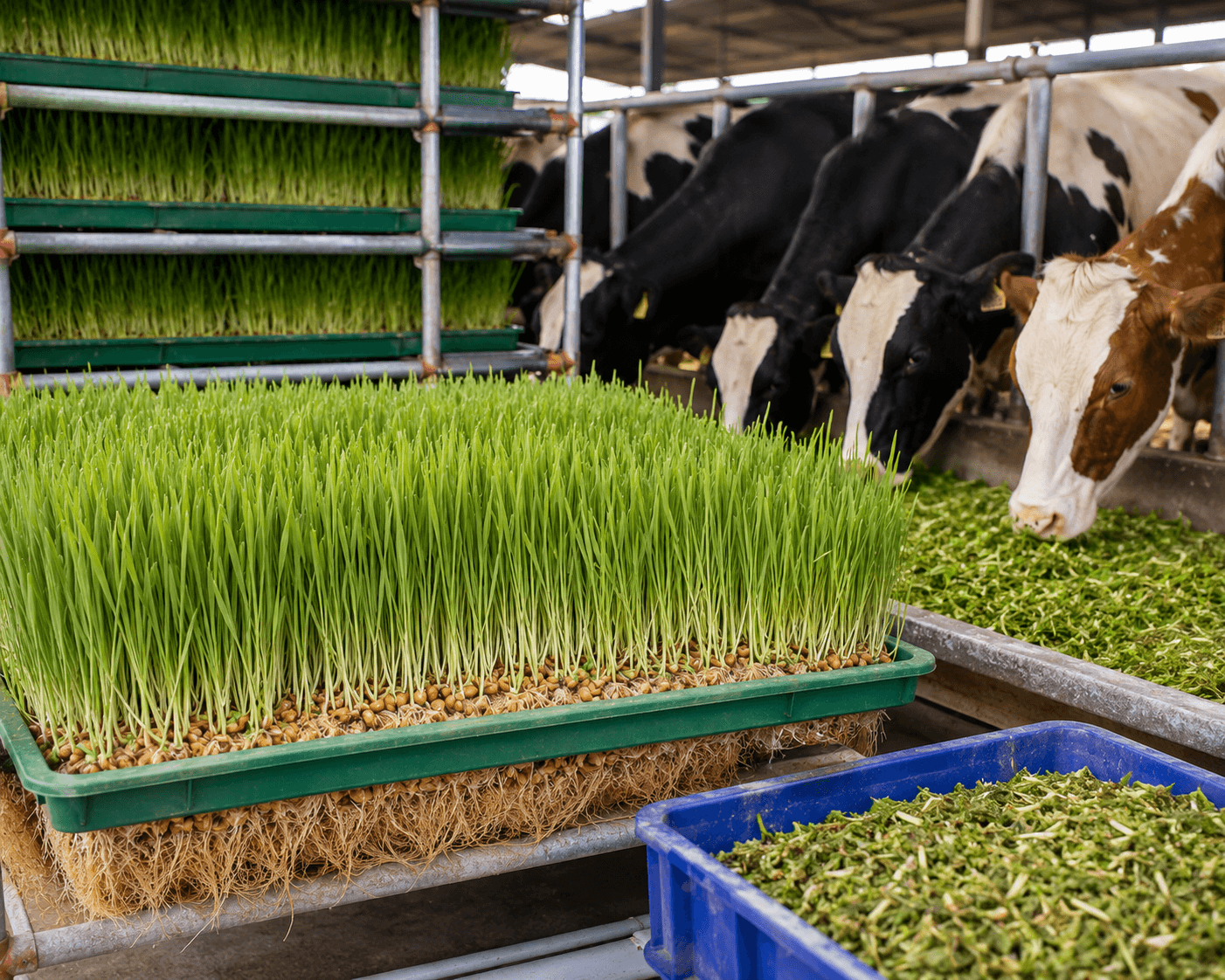
Hydroponic Green Fodder for Indian Dairy
Simple guide to hydroponic green fodder for Indian dairy: how to grow fresh green fodder from barley seeds in 7 days, setup cost, feeding rates, benefits, problems, and is it worth it for your farm.
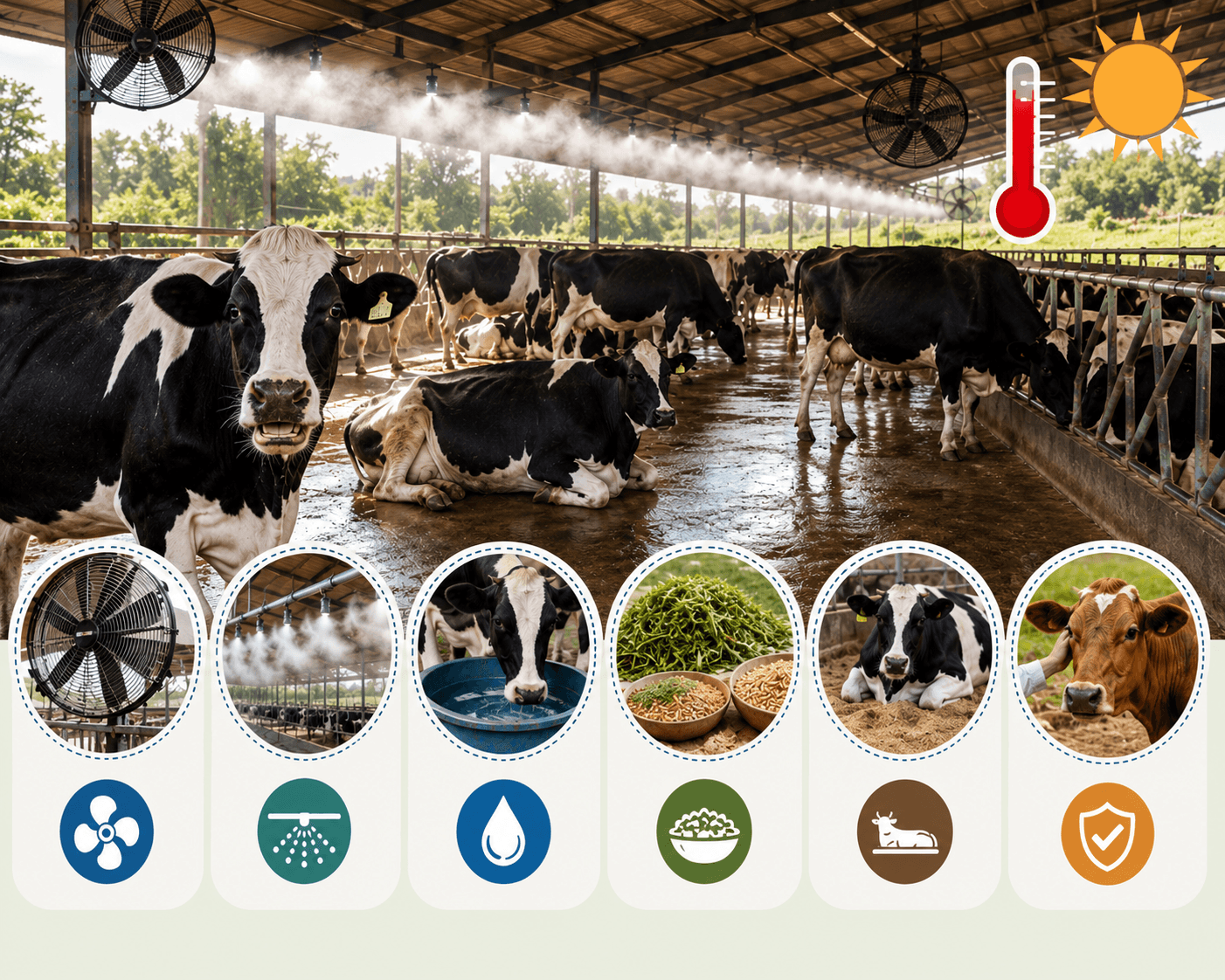
Heat Stress in Dairy Cattle: How to Manage Summer in India
Simple guide to managing summer heat stress in Indian dairy cattle and buffalo: signs to watch for, cooling methods (shade, fans, sprinklers, wallowing), feed changes, and how to keep milk yield steady in May-June.
Acidosis in Dairy Cattle: Causes, Prevention & Treatment
Complete guide to rumen acidosis in dairy cattle: why maize-heavy rations cause it, milk fat depression as the early warning, prevention with sodium bicarbonate (meetha soda) buffer, and treatment for clinical cases.