Feeding Lactating Buffalo: Complete Ration Guide
By Vrap · Published Mon May 18 2026 00:00:00 GMT+0000 (Coordinated Universal Time) · Updated Mon May 18 2026 00:00:00 GMT+0000 (Coordinated Universal Time)
Why lactating buffalo feeding is different from cow feeding
A lactating buffalo isn't just a bigger cow. The biggest nutritional difference is in the milk itself: buffalo milk averages 6 to 7 percent fat, almost double the 3.5 to 4.5 percent in cow milk. That extra fat doesn't come for free — it has to be produced from the energy in the ration, which means a lactating buffalo needs a denser, more energy-rich feed than a cow producing the same volume of milk.
There are three practical consequences:
- Higher energy requirement per litre of milk. A buffalo yielding 8 litres of 6.5% fat milk needs roughly the same energy as a cow yielding 12 litres of 4% fat milk.
- More dietary fat in the ration. The most efficient way to deliver concentrated energy is from fat — every gram of fat carries 2.25 times the energy of a gram of carbohydrate. A buffalo ration usually targets 5–7% ether extract (fat) on a dry-matter basis, vs 3–5% for a cow ration.
- More heat sensitivity. Buffalo dissipate heat less efficiently than cows. In Indian summers, intake drops significantly above 35°C ambient temperature, so the ration must be more nutrient-dense to deliver the same kg of nutrients in less feed.
This guide covers a balanced lactating buffalo ration for typical Indian dairy conditions, the role of fat-rich ingredients, and how to adjust for breed, yield, and season.
Dry matter intake (DMI) requirements
| Buffalo body weight | DMI (2.5–3% of body weight) |
|---|---|
| 400 kg | 10–12 kg/day |
| 500 kg | 12.5–15 kg/day |
| 600 kg | 15–18 kg/day |
| 700 kg | 17.5–21 kg/day |
These are dry matter — the actual quantity of feed will be 3–4× higher for green fodder and roughly equal for dry fodder and concentrate.
A typical 500 kg Murrah buffalo yielding 8–10 litres a day will eat:
- 25–30 kg fresh green fodder (~5–6 kg DM after subtracting the water content)
- 4–5 kg dry fodder or straw (~4–4.5 kg DM)
- 5–6 kg concentrate mix (~5–5.5 kg DM)
- Total: ~14–16 kg DM/day
Energy and protein targets
The complete ration (forage + concentrate combined) should hit these targets on a dry-matter basis:
| Nutrient | Lactating buffalo target | Lactating cow target (for reference) |
|---|---|---|
| Crude protein (CP) | 20% min | 16–18% |
| Total digestible nutrients (TDN) | 65–70% | 60–65% |
| Ether extract (fat) | 5–7% | 3–5% |
| Calcium | 0.6–0.8% | 0.6–0.8% |
| Phosphorus | 0.35–0.45% | 0.35–0.45% |
| Effective fibre | 19–22% NDF | 19–22% NDF |
Two targets matter most: the 20% minimum crude protein (vs the 16–18% target a cow would accept) and the 5–7% fat (vs 3–5% for a cow). These two together — more protein and more fat — are the formulation differences that distinguish a buffalo ration from a cow ration.
To compute the actual DCP and TDN of your specific ration, use our DCP and TDN calculator. To price out the ration with today's India prices, use the ration cost calculator.
Why a buffalo needs more fat in the ration
Buffalo milk is unique because of its very high fat content. The mammary gland needs both energy (to power synthesis) and direct lipid precursors (long-chain fatty acids) to build that milk fat. Three things follow:
- Carbohydrate energy alone is not enough at high yields. A lactating buffalo at peak yield can't physically eat enough grain-only concentrate to meet its energy demand without risking acidosis. Adding fat raises energy density without raising the rapidly-fermentable starch load.
- Dietary fat is conserved more efficiently for milk fat than dietary carbohydrate, which has to go through several metabolic conversions.
- Heat stress reduces intake in Indian summers. A fat-rich ration delivers more energy per kilogram of intake, partially compensating for the summer intake drop.
Sources of fat in buffalo feed
There are five common ways to raise the fat content of a buffalo ration. Most farms use a combination of these.
| Fat source | Typical fat content | Inclusion in ration | Notes |
|---|---|---|---|
| Bypass fat (rumen-protected) | 80–85% | 100–300 g/buffalo/day, top-dressed | Highest fat density, rumen-safe, ideal for high-yield buffalo |
| Full-fat rice bran | 12–18% | 5–10% of concentrate | Cheap, widely available; rancidity risk in storage |
| Cottonseed cake (expeller) | 5–8% | 15–25% of concentrate | Combines protein + fat; gossypol tolerated by ruminants |
| Groundnut cake (expeller) | 6–10% | 10–15% of concentrate | High protein, good fat; watch for aflatoxin in monsoon |
| Mustard oil cake | 7–10% | 8–12% of concentrate | Common in north India; glucosinolates limit inclusion |
Bypass fat in detail
Bypass fat (also called "rumen-protected fat" or "calcium soap of long chain fatty acids") is the most efficient fat source for a high-yielding buffalo. It is manufactured by saponifying palm or vegetable fatty acids with calcium, producing a powder or granular product that passes through the rumen undisturbed and is absorbed in the small intestine.
Practical dosing:
- Start at 50–100 g/buffalo/day for the first week
- Increase to 150–200 g/day in week 2–3
- Maintain at 200–300 g/day at peak lactation (first 100 days)
- Reduce to 100–150 g/day in late lactation
- Stop completely 2 weeks before dry-off
Where bypass fat helps most:
- High-yielding buffalo (>10 L/day)
- The first 60–100 days of lactation when nutrient demand outstrips intake capacity
- Summer months when ambient heat suppresses appetite
Full-fat rice bran
Rice bran with the oil intact contains 12–18% fat. The same product after solvent extraction becomes DORB (de-oiled rice bran) at 1–2% fat. Use full-fat rice bran when fat content is what you need; use DORB when fibre and protein at lower energy density is what you need. Full-fat rice bran goes rancid within 2–3 weeks of milling, so buy fresh and use fast.
A sample lactating buffalo ration
This is a typical Indian dairy ration for a 500 kg Murrah buffalo yielding 8–10 litres/day at 6.5% fat, in mid-lactation.
Forage component
| Ingredient | Quantity (fresh) |
|---|---|
| Green fodder (maize/jowar/lucerne/berseem) | 25–30 kg |
| Dry fodder (paddy straw/wheat straw/jowar kadbi) | 4–5 kg |
Concentrate mix (5 kg/buffalo/day)
| Ingredient | % of concentrate | Quantity (in 5 kg) |
|---|---|---|
| Maize (cracked) | 25% | 1.25 kg |
| Soybean meal (46% protein) | 18% | 0.90 kg |
| Cottonseed cake (decorticated) | 20% | 1.00 kg |
| Groundnut cake or mustard cake | 10% | 0.50 kg |
| Wheat bran or DORB | 19% | 0.95 kg |
| Molasses | 5% | 0.25 kg |
| Mineral mixture | 2% | 0.10 kg |
| Salt | 1% | 0.05 kg |
Top-dressed daily
- Bypass fat: 150–250 g/day (sprinkled over the concentrate at feeding)
Approximate nutritional outcome
- Total DM intake: ~14 kg
- Concentrate CP: ~20% (the minimum target for a lactating buffalo concentrate)
- Total ration CP: ~17–19% on DM basis (depends on forage; legume-rich forage like berseem or lucerne pushes it higher)
- TDN: ~67% on DM basis
- Fat (ether extract): ~6% on DM basis
This is a representative formula — adjust ingredient percentages within their typical ranges based on regional availability and price. If the green fodder is mostly grass rather than legume, increase soybean meal further to compensate for lower forage protein.
Adjusting the ration by yield
| Daily milk yield | Concentrate per day | Bypass fat per day |
|---|---|---|
| 4–6 L | 3 kg | 0–100 g |
| 6–8 L | 4 kg | 100–150 g |
| 8–10 L | 5 kg | 150–250 g |
| 10–12 L | 6 kg | 200–300 g |
| 12+ L | 7 kg | 250–350 g |
A rough rule used in Indian dairy practice: 1 kg of concentrate for every 2 litres of milk produced, plus 1.5–2 kg of maintenance concentrate regardless of milk yield.
Breed-specific notes
| Breed | Mature body weight | Typical milk yield | Notes |
|---|---|---|---|
| Murrah | 450–550 kg | 8–12 L/day | The most widely commercial dairy breed in India; the ration above is sized for Murrah |
| Jaffrabadi | 550–650 kg | 6–10 L/day | Larger frame, needs proportionally more concentrate and forage |
| Mehsana | 400–500 kg | 6–8 L/day | Hardy, well-suited to Gujarat conditions |
| Surti | 350–450 kg | 4–6 L/day | Smaller buffalo, lower concentrate needs |
| Nili-Ravi | 500–600 kg | 8–10 L/day | Punjab-Haryana belt; similar to Murrah in nutrition |
The principles in this article apply to all Indian buffalo breeds. Only the absolute daily quantities scale with body weight and milk yield.
Common mistakes when feeding lactating buffalo
- Underfeeding fat. Many farmers feed a cow-style ration to a buffalo and wonder why milk fat percentage is low and yield drops in the second month of lactation. Buffalo need 5–7% dietary fat, not 3–5%.
- Overfeeding concentrate without enough forage. Pushing concentrate to 8 kg without adequate fibre causes acidosis, dropped milk fat, and laminitis. Maintain at least 40% of total DM as forage.
- Ignoring water. A buffalo missing access to water for even half a day will drop 1–2 litres of milk. Water troughs must be clean and constantly full.
- Sudden ration changes. Switching ingredients abruptly causes rumen upset. Transition over 1–2 weeks.
- Skipping mineral mixture. Cattle-grade mineral mixture is cheap (~₹95/kg) but skipping it costs in lower milk yield, weak heat signs, and silent infertility. 100–150 g/day is essential.
- Feeding wet, mouldy maize. Aflatoxin in maize passes into buffalo milk as aflatoxin M1, with the same regulatory limit (0.5 µg/kg) as cow milk. See our maize article for moisture and aflatoxin discipline.
Water requirements
A lactating buffalo drinks 60–100 litres of water per day, scaling with milk yield, ambient temperature, and dry matter content of the feed:
- 60 L/day for a 6 L/day yielder in winter
- 80 L/day for an 8–10 L/day yielder in average temperatures
- 100+ L/day in peak summer or for high-yielding animals
Water should be freely available 24 hours a day. Inadequate water is the single most common silent cause of dropped milk yield on Indian smallholder dairies.
Mineral and vitamin requirements
Bulk minerals (Ca, P, Mg, Na, K, S) and trace minerals (Zn, Mn, Cu, Fe, Co, I, Se) must come from a compounded mineral mixture. Fat-soluble vitamins A, D, and E are usually supplied as a premix mixed into the mineral mixture or top-dressed separately.
Practical guidelines:
- Mineral mixture: 100–150 g/buffalo/day
- Common salt: 50–100 g/buffalo/day (separate from mineral mixture or already included in it)
- Vitamin AD3E premix: as per manufacturer label, typically 10–15 g/day in the concentrate
Lactating buffalo on green-fodder-only diets without compound mineral mixture often show milk-fever risk at calving, weak silent heats, and reduced conception rates. This is one of the cheapest, highest-ROI interventions in Indian buffalo dairy.
Conclusion
Feeding a lactating buffalo well is about respecting the buffalo's biology: it makes fattier and richer milk than a cow and needs a denser ration to do so. Get the dry matter intake right (2.5–3% of body weight), hit 20% minimum crude protein and 65–70% TDN on a DM basis, push fat to 5–7%, supply 60–100 L of water, and don't skip the mineral mixture. The reward is higher milk yield, healthier animals, and faster return to heat after calving — the three things that decide whether a buffalo dairy is profitable.
Frequently asked questions
How much dry matter does a lactating buffalo eat per day?+
Why does a buffalo need more fat in its feed than a cow?+
What is bypass fat and how much should a lactating buffalo get?+
What is the difference between feeding a Murrah and a Jaffrabadi buffalo?+
What is a balanced concentrate mix for a lactating buffalo?+
How much water does a lactating buffalo drink per day?+
Related articles
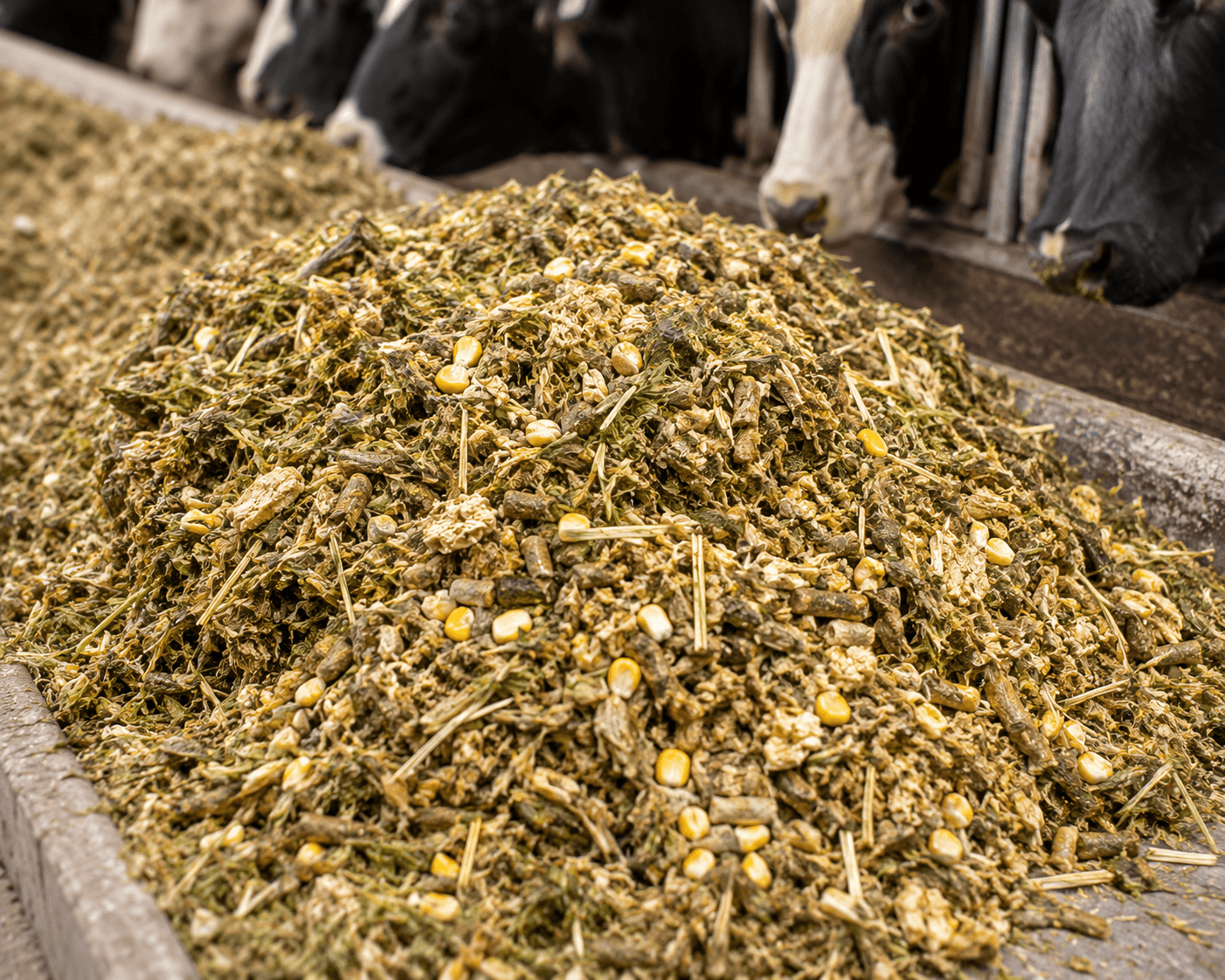
Total Mixed Ration (TMR) for Dairy Cattle
Complete guide to Total Mixed Ration (TMR) in Indian dairy: what TMR is, why it matters, how to formulate one, sample lactating buffalo TMR in kg, particle size, moisture, and common mistakes.
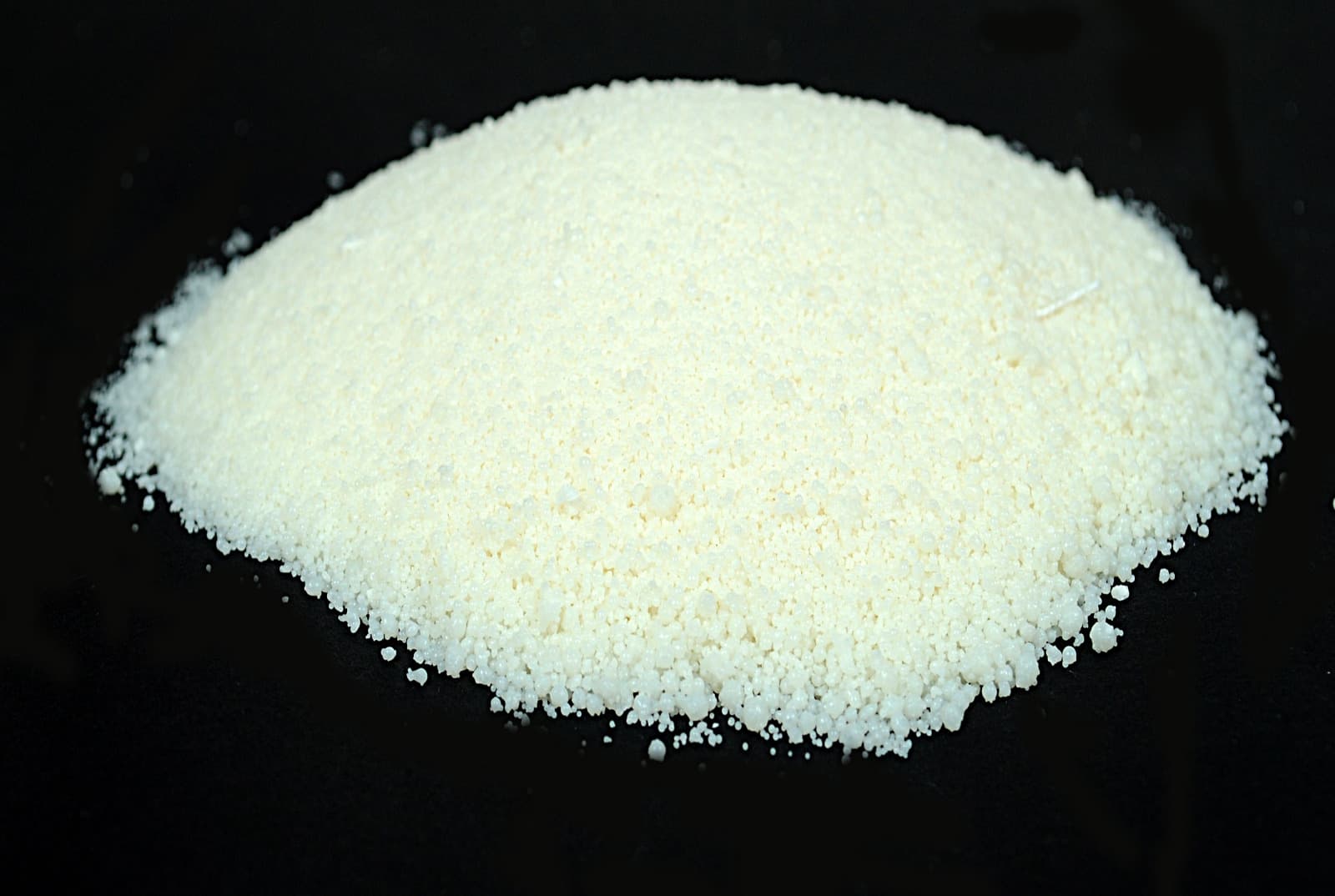
Bypass Fat in Cattle Feed
Complete guide to bypass fat (rumen-protected fat) in Indian cattle feed: prilled hydrogenated vs calcium soap types, analytical specs, dosing by milk yield, when to use, and ROI.
Feeding Lactating Cow: Complete Ration Guide
Complete guide to feeding lactating dairy cows in Indian dairy: how to choose between Type-1 and Type-2 compound feed by milk yield, sample rations, 21-day feed transition protocol, and breed-specific notes.