Wheat Bran (Gehu Chokar) in Cattle Feed
By Vrap · Published Mon May 18 2026 00:00:00 GMT+0000 (Coordinated Universal Time) · Updated Mon May 18 2026 00:00:00 GMT+0000 (Coordinated Universal Time)
What is wheat bran?
Wheat bran — known across India as gehu chokar — is the outer layers of the wheat kernel that are separated during the milling of wheat into atta (whole wheat flour) and maida (refined white flour). It is one of the most traditional Indian cattle feed ingredients, used directly on dairy farms for generations as a moderate-protein, moderate-energy concentrate component.
For dairy cattle, buffalo, sheep, and goats, gehu chokar serves three roles at once: it supplies digestible protein at around 15%, contributes moderate energy at 65–70% TDN, and provides physical bulk and effective fibre that supports rumen health. That combination — protein, energy, and fibre in one ingredient — is what made wheat bran a staple of Indian smallholder dairy long before DORB became widely available. The current India market price for wheat bran is updated daily on our wheat bran price page.
The three types of wheat bran in India
A practical observation that nobody outside the milling and feed industries usually knows: Indian flour mills produce wheat bran in three distinct grades by particle size, and the grade you receive depends both on the mill and on the local market preference.
| Grade | Particle size | Description | Best use |
|---|---|---|---|
| Coarse bran (moti chokar) | Large flakes | More outer-layer content, slightly higher fibre, more visible bran particles | Direct dairy feeding on farms; high palatability for cattle and buffalo |
| Fine bran | Smaller particles | Some endosperm content mixed in, slightly higher TDN, less fibre | General compound feed use; smaller ruminants |
| Super fine bran (atta chokar) | Very fine, close to flour | Almost flour-like; highest endosperm fraction; often a by-product of premium atta milling | Calf feed, finishing rations, where small particle size matters |
The three grades have similar overall nutritional values — protein, fat, and TDN are within a few percentage points of each other across the grades. The main practical difference is handling and palatability:
- Coarse bran is preferred by smallholder dairies and traditional buyers because it is visually distinct as bran (less risk of being passed off as something else), mixes well with other ingredients in farm-mixed concentrates, and has good palatability for adult animals.
- Fine bran flows better through compound feed manufacturing equipment, but its visual similarity to flour-like products can hide adulteration.
- Super fine bran is closest to flour and is the choice for calf starters and other rations where particle size needs to be small.
A farmer comfortable buying from a known mill can choose freely. A first-time buyer should prefer coarse bran from a reputable source until trust is established with the supplier.
Nutritional profile
| Parameter | Typical value |
|---|---|
| Dry matter | 88–90% |
| Crude protein | 14–17% (typical ~15%) |
| Crude fat | 3–4% |
| Crude fibre | 10–12% |
| TDN (Total Digestible Nutrients) | 65–70% |
| Calcium | 0.1% |
| Phosphorus | 1.0–1.3% (mostly phytate-bound) |
| B-complex vitamins | Useful levels of B1 (thiamine), niacin, folate |
Two notable nutritional features:
- Phosphorus content is high at 1.0–1.3%, but most of it is bound as phytate. Ruminants can release a fraction of this phytate-phosphorus via rumen microbial phytase, making wheat bran a moderate phosphorus contributor for cattle and buffalo (less effective in monogastrics).
- B-vitamin content is useful — wheat bran is one of the better natural sources of thiamine, niacin, and folate among common Indian feed ingredients. While ruminants synthesise B vitamins in the rumen, supplemental dietary B vitamins still contribute to overall nutrition.
To compute the DCP and TDN of any ration including wheat bran, use our DCP and TDN calculator.
Why wheat bran is losing share to DORB in compound pellets
For decades, wheat bran was the default bulk-and-fibre ingredient in both farm-mixed concentrates and compound cattle feed pellets across India. In the last several years, that has changed.
The price gap
- Wheat MSP (Minimum Support Price) has risen significantly through repeated government revisions
- Government wheat procurement intensified, tightening domestic wheat supply
- Flour mill margins compressed, raising wheat bran's farm-gate price
- Meanwhile, DORB prices have stayed comparatively stable — DORB remains a true by-product of rice oil extraction
The result is that wheat bran now trades meaningfully more expensive than DORB on a per-kilogram basis in most Indian wholesale markets, even though their nutritional profiles are broadly similar:
| Parameter | Wheat bran | DORB |
|---|---|---|
| Crude protein | 14–17% | 16–17% |
| Crude fibre | 10–12% | 12–14% |
| TDN | 65–70% | 55–60% |
| Crude fat | 3–4% | under 2% |
| Pellet-binding properties | Moderate | Strong (natural starch binder) |
| Typical price per kg | Higher | Lower |
How feed mills responded
Compound cattle feed manufacturers, who buy thousands of tons of bulk ingredient each year, have shifted strongly toward DORB. A typical Type-2 compound feed formula that once carried 20–25% wheat bran often now carries 5–10% wheat bran and 20–30% DORB — reversing the historical proportions. The pellet still meets BIS specifications, the cost per ton is lower, and DORB's natural pellet-binding properties simplify manufacturing.
Where wheat bran still wins
Wheat bran has not disappeared. It still has a clear advantage in three settings:
- Direct farm-mixed concentrates — for a smallholder dairy mixing 50 kg of concentrate per day by hand, wheat bran's palatability and clean handling outweigh the small price disadvantage vs DORB
- Calf and heifer feeding — wheat bran's softer, less-coarse texture is gentler on young animals' digestive systems than higher-fibre DORB
- Regions where wheat bran is locally cheap — Punjab, Haryana, parts of UP and MP — where milling is on-doorstep and freight is zero
Regional and state-wise differences
Wheat is concentrated in the rabi crop of north India, and wheat milling follows the wheat-growing belt. This creates clear regional differences in both wheat bran price and typical form:
| State / region | Role and characteristics |
|---|---|
| Punjab, Haryana | Heart of Indian wheat production. Milling capacity is dense. Wheat bran is abundant, cheap, and typically supplied as coarse moti chokar. Preferred by direct-feeding dairies. |
| Uttar Pradesh | Largest wheat-producing state. Mills produce both coarse and fine bran depending on the buyer. Pricing competitive within the state. |
| Madhya Pradesh, Rajasthan | Significant wheat producers. Local mills supply local dairy demand at competitive prices. |
| Bihar | Mixed wheat-and-rice belt. Wheat bran supply is meaningful but less dominant than UP. |
| Maharashtra, Gujarat | Outside the wheat belt. Wheat bran arrives by truck from northern states. Landed price is higher; form is often pre-ground fine bran for easier handling and lower freight volume. |
| Southern India (Karnataka, Tamil Nadu, AP, Telangana, Kerala) | Furthest from wheat-growing regions. Wheat bran is expensive on a landed basis. Many southern compound feed mills use less wheat bran and more locally-available alternatives. Form is usually fine bran. |
| West Bengal | Mixed availability; some local production plus imports from UP and Bihar. |
A practical implication: a buyer in Maharashtra paying ₹3-5/kg more for wheat bran than a buyer in Punjab should expect their ration to reflect this — either by accepting the higher cost, or by partial substitution with DORB or other locally cheaper bulk ingredients.
Inclusion rates by animal and life stage
The following assume wheat bran is being added to a balanced concentrate mix containing protein ingredients (soybean meal, oilseed cakes), energy ingredients (maize), and mineral mixture.
| Animal / stage | Wheat bran in concentrate mix | Notes |
|---|---|---|
| Lactating cow | 10–20% | Pairs with maize for energy and soybean meal for protein |
| Lactating buffalo | 10–15% | Lower end — buffalo benefit more from fat-rich ingredients like cotton seed cake |
| Calf starter (3–6 months) | 10–15% | Wheat bran's softer texture is gentler for young calves than coarser fibre sources |
| Heifers | 15–25% | Excellent bulk ingredient for growth phase |
| Dry cow / dry buffalo | 15–25% | Higher end — maintenance fibre helps prevent over-conditioning |
| Adult sheep / goat | 10–15% | Good palatability for small ruminants |
| In compound pellet formulations (modern) | 5–10% | Reduced from historical 15–20% due to DORB price advantage |
| In farm-mixed concentrates | 15–25% | Where wheat bran is locally cheap, this remains the traditional inclusion |
The maximum useful inclusion is around 25% of the concentrate. Beyond that, total fibre content rises beyond what supports good rumen function for high-yielding animals.
Direct farm use vs compound pellet use
A practical observation from the Indian market: wheat bran retains a stronger position in direct farm-mixed concentrates than in factory-made compound pellets.
In farm-mixed concentrates
- Wheat bran's clean visual identity and physical bulk make it easy to mix by hand
- Coarse bran (moti chokar) is highly palatable for cattle and buffalo
- The price disadvantage vs DORB is smaller when buying small quantities
- Long tradition — smallholder dairies have used wheat bran for generations
In compound pellet formulations
- DORB's natural starch binding properties simplify pellet manufacturing
- DORB's lower price improves margins for the manufacturer
- Pellet uniformity is easier with DORB than with mixed bran particle sizes
- Wheat bran has become a 5–10% supporting ingredient rather than a primary 20% bulk component
For a dairy operator deciding between buying compound feed vs mixing their own concentrate, this is one consideration: the wheat bran in farm-mixed concentrate is one of the things that gives it its traditional character.
Quality standards: what to check before buying
A reputable Certificate of Analysis for feed-grade wheat bran should report:
| Parameter | Acceptable specification |
|---|---|
| Crude protein (min) | 14% |
| Crude fibre (max) | 12% |
| Moisture (max) | 11% |
| Total ash (max) | 7% |
| Acid insoluble ash (max) | 2.5% |
| Aflatoxin B1 (max) | 20 ppb (per BIS dairy cattle feed limit) |
Visual + smell checks before accepting delivery:
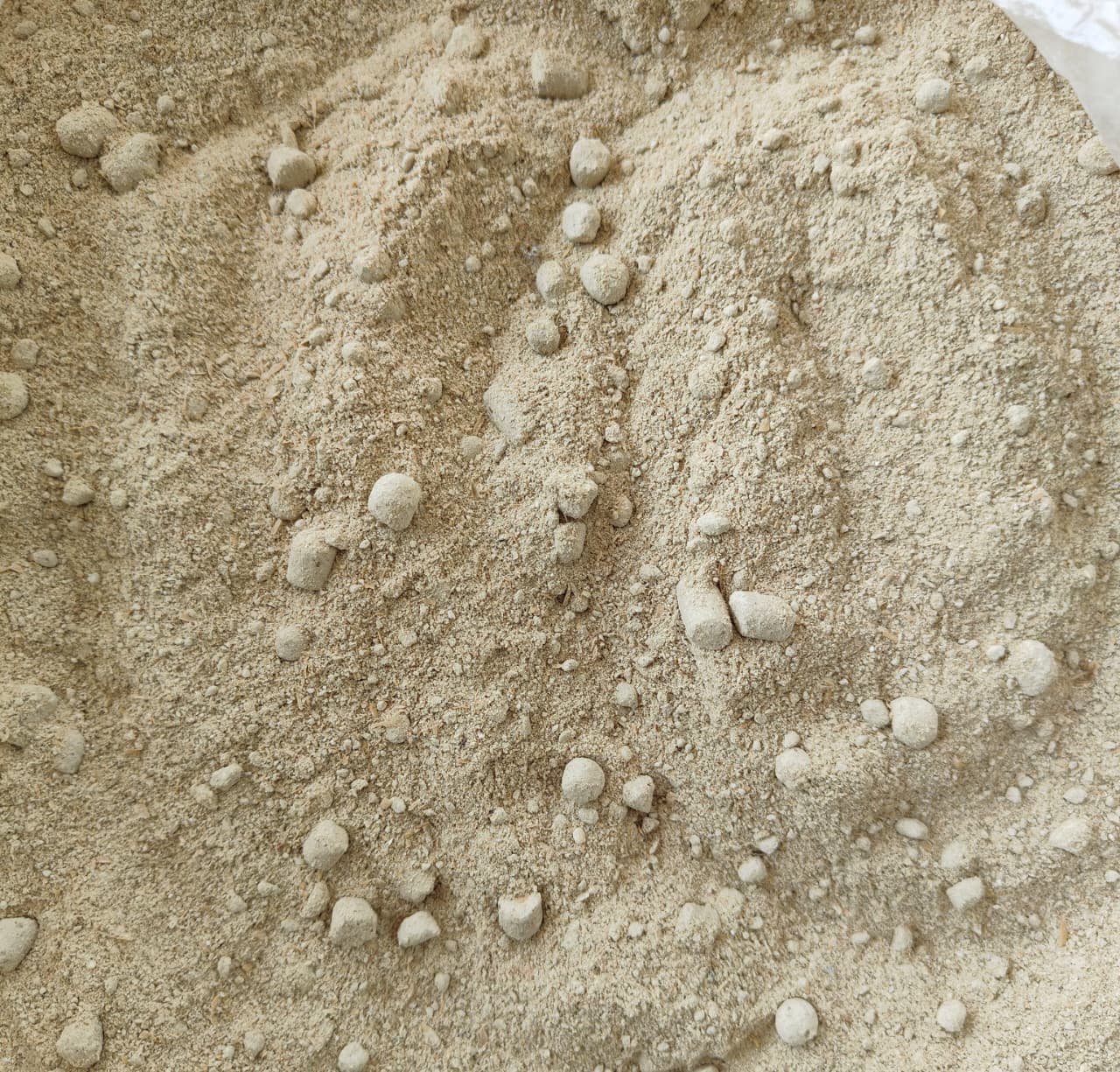
- Colour: uniformly light brown to medium brown for coarse bran; pale beige for fine bran. Greyish-white particles = adulteration with sawdust or rice husk
- Smell: fresh, slightly sweet, wheaty. Sour or mouldy smells = reject
- Texture: dry, flaky for coarse bran; powdery for fine bran. Damp, clumpy material = mould risk
- Foreign matter: should be minimal. Visible stones, soil, or non-wheat material = reduced value
- Float test (quick farm check): pure wheat bran in water mostly floats or suspends. Heavy sand drops to the bottom; light sawdust floats noticeably
Common adulteration to watch for
Wheat bran is sometimes adulterated with:
- Sawdust — visually similar light particles, lowers nutritional value, no aflatoxin risk but worthless as feed
- Paddy husk / rice husk — long fibrous particles, very high fibre, low protein
- Sand or soil — bulks up tonnage, detected by acid insoluble ash > 2.5%
- Other (cheaper) brans — sometimes mixed in; harder to detect without microscopy
The acid insoluble ash test catches most filler adulteration. The visual inspection for husk particles is also effective.
Storage best practices
Wheat bran stores better than groundnut cake or full-fat rice bran because:
- The low fat content (3–4%) means rancidity is slow
- Aflatoxin risk is lower than maize or groundnut (though not zero)
- The dry, friable texture handles humidity better than oilier ingredients
Standard discipline:
- Off-floor stacking on wooden or plastic pallets
- Bag stacking maximum 12–15 high
- Cool, dry storage below 70% relative humidity
- FIFO rotation to use older stock first
- Buffer time — 2–3 months comfortable; up to 4 months with good storage
- Pest control — rodents and insects are attracted; standard fumigation cycle applies
Comparison vs other bulk ingredients
| Ingredient | Crude protein | Crude fat | TDN | Typical inclusion | Notes |
|---|---|---|---|---|---|
| Wheat bran | 14–17% | 3–4% | 65–70% | 10–25% | Higher price than DORB; better palatability and B vitamins |
| DORB | 16–17% | under 2% | 55–60% | 15–30% | Cheaper, better pellet binder, slightly lower energy |
| Maize | 9–10% | 3.5–4.5% | 78–82% | 10–35% | Pure energy ingredient; lower protein |
| Rice polish (full-fat) | 12–14% | 14–20% | 75–85% | 5–10% | Very energy-dense; high rancidity risk |
In a modern compound feed pellet, the bulk ingredient slot is increasingly filled by DORB (price advantage) supported by wheat bran (palatability and B vitamins). In a farm-mixed concentrate, wheat bran retains a larger share for handling and tradition reasons.
Conclusion
Wheat bran — gehu chokar — has been the workhorse of Indian cattle feed for generations. At 14–17% crude protein, 65–70% TDN, and useful B-vitamin and phosphorus contributions, it remains a solid bulk-and-moderate-energy concentrate ingredient. The three grades (coarse moti chokar, fine, super fine) suit different end uses and different market preferences across the country.
The market is shifting. Rising wheat bran prices (driven by MSP increases and government procurement) and stable DORB prices have made DORB the cheaper bulk ingredient choice in compound pellet manufacturing. Wheat bran's share in modern pellet formulations has declined from historical highs.
But the commodity is far from going away. Direct farm-mixed concentrates in north Indian smallholder dairies, calf and heifer rations where particle size matters, and regions where wheat bran is locally cheap all retain wheat bran as a primary ingredient. For most Indian dairies, wheat bran is still in the feed bin — just usually next to DORB rather than replacing it.
Frequently asked questions
What is gehu chokar?+
What are the three types of wheat bran available in India?+
What is the protein content of wheat bran?+
Why is wheat bran being slowly replaced by DORB in compound cattle feed?+
Why do wheat bran prices and forms differ so much state to state in India?+
What is the right inclusion rate of wheat bran in cattle feed?+
Related articles
De-Oiled Rice Bran (DORB) in Cattle Feed
Complete guide to DORB in Indian cattle feed: nutrition (16-17% CP, 12-14% CF), why it is the main raw material for compound feed pellets, BIS aflatoxin limit, adulteration tests, and inclusion rates.

Maize DDGS, Rice DDGS and Maize DOC in Cattle Feed
Complete guide to DDGS in Indian cattle feed: Maize DDGS (28-30% protein, 8-10% fat), Rice DDGS (45% protein), Maize DOC (de-oiled, <2% fat). What different DDGS colours mean for quality, the critical aflatoxin risk, and inclusion rates.
Maize as Cattle Feed
Complete guide to maize in Indian cattle feed: protein and starch profile, the 10–35% inclusion rate, moisture and aflatoxin limits, acidosis prevention, processing, and storage.